Science 1,141 views on YouTube
Cascadia: "The Big One" Is Not the Worst Case
Cascadia is a fault off the coast of northern California, Oregon, Washington and Vancouver Island, where one slab of sea floor is being pushed underneath the North American plate. The two have been stuck together since January 1700. When a fault like that finally lets go, it moves for minutes.
To see what that looks like, look at Japan in 2011. Same kind of fault, same magnitude. And Japan matters twice here, because when Cascadia last let go, the wave crossed the Pacific and Japanese officials wrote it down without knowing what had caused it.
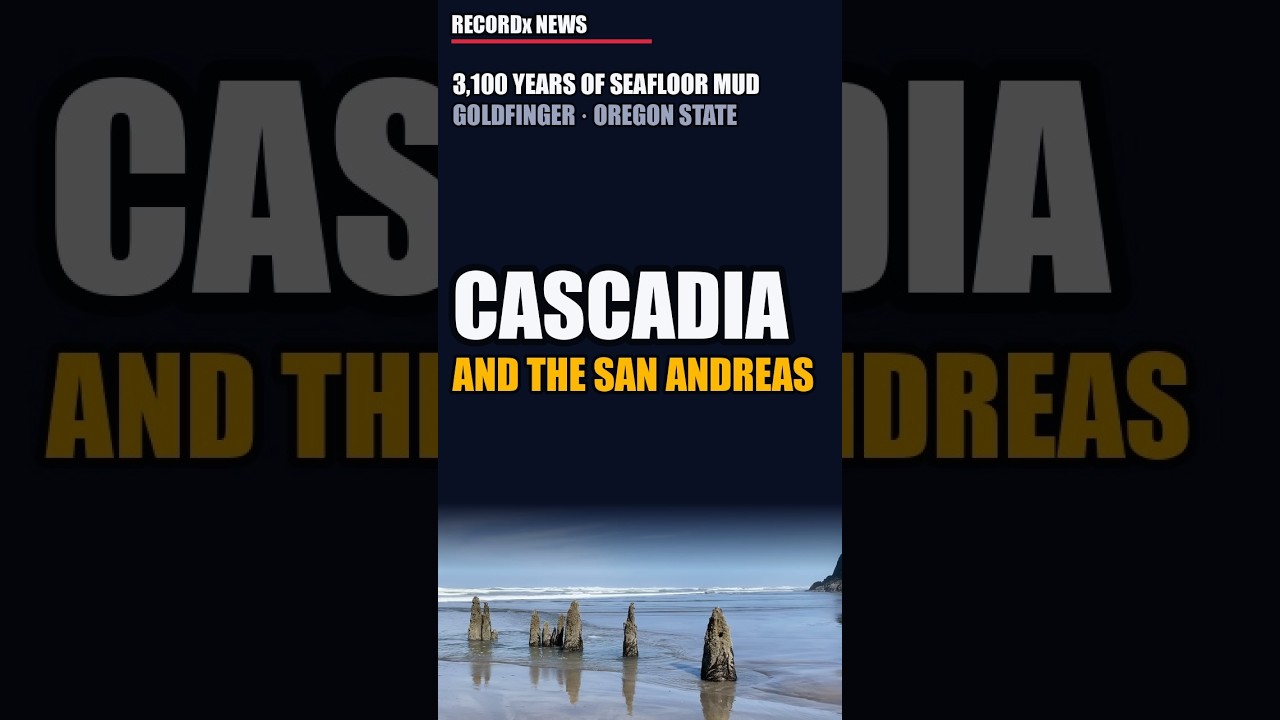
Then a marine geologist at Oregon State pulled 3,100 years of seafloor mud from the Mendocino Triple Junction and found Cascadia's ruptures turning up beside ruptures on the northern San Andreas. 18 events, 10 linked in time, 8 stacked so closely the two faults look like one story. 1700 appears to be one of the pairs.
The reporting
Slug cascadia-2026-08-23 · Status RESEARCH + INGEST done, nothing written or cut yet. Seed Astrum Earth, The Quake That Will Reshape America, 17 Aug 2026, 34:23, 1.51M views.
The story
The Cascadia Subduction Zone runs ~1,000 km from northern California to Vancouver Island and last ruptured on 26 January 1700 at about M9. The familiar framing is "the Big One" — one catastrophic megathrust. The new finding is that this may be the optimistic version.
Chris Goldfinger (Oregon State) et al., _Geosphere_ 2025;21(6):1132 read ~3,100 years of deep-sea turbidites near the Mendocino Triple Junction and found Cascadia ruptures repeatedly paired with ruptures on the northern San Andreas — including 1700. His own line: "It turns out it's not the worst case scenario."
This is the angle, and it comes with a discipline problem. The May 2026 press wave ran it as "two megaquakes at once, San Francisco to Vancouver." Goldfinger in Eos is far more careful:
"It could be anything from minutes to decades."
Kathryn Materna (CU Boulder), quoted in the same piece, on why it is surprising at all:
"Because these faults tend to unleash earthquakes at different rates, there's no reason their events should line up closely."
Any cut we make states the pairing AND the range. Stamping "at the same time" would be the Disney-Legend trap with a fault line.
Proposed output
- Doc (~5 min) — 1. What Cascadia is · 2. How we know about 1700 (ghost forests + the orphan tsunami) · 3. What a rupture does (shaking, subsidence, tsunami timing) · 4. The twin-threat finding · 5. What is and isn't ready.
How this was verified — the rest of the fact sheet
Open calls
- Short first, or straight to the doc? (El Niño went short → doc and the short's beds fed it.)
- The FEMA casualty figure needs a primary source or it stays off screen.
- Which probability do we lead with — OSU's 37% or the PNAS 15%? They answer different questions (M8+ vs full rupture) and must not be blended.
Fact discipline held. The card reads MINUTES / OR DECADES, not "at the same time" — the honest range from Goldfinger's own words in Eos. The contested probability figures and the unsourced FEMA casualty number stayed off screen entirely.
References
Reporting drawn from Goldfinger et al · Geosphere 2025;21(6):1132 - Eos (12 Nov 2025) - Oregon State Newsroom - Dura et al · PNAS 10.1073/pnas.2424659122 - Oregon Dept of Emergency Management - PBS Terra - Astrum Earth
What the reel says
Narration as scripted and voiced.
Off the coast of Northern California, Oregon, Washington, and Vancouver Island, one slab of the seafloor is being pushed underneath the North American plate. That boundary is called Cascadia, and it has been stuck for 326 years. When a fault like that finally lets go, it does not shudder. It moves for minutes.
We knew that Northeast Japan wasn't expected to have anything bigger than about an 8.4. But when it hit three minutes and went past three minutes, we knew that was wrong. We were going, this is a nine. It has to be a nine. That's what it takes. Three minutes.
That was Japan in 2011. The same kind of fault, the same magnitude. And Japan matters twice in this story. Because when Cascadia last let go in 1700, the wave crossed the Pacific. And Japanese officials wrote it down without ever knowing what had caused it.
For decades, the nightmare had a single name, the big one. Then a marine geologist at Oregon State pulled 3,100 years of seafloor mud from the Mendocino Triple Junction and found something nobody expected. Cascadia's ruptures keep turning up beside ruptures on the northern San Andreas. 18 events, 10 of them linked in time. Eight of them stacked so closely that the two faults look like one story.
Chris Goldfinger's own summary of the finding is the line that should worry you. It turns out it is not the worst case scenario. 1700 appears to be one of those pairs. San Francisco and the Pacific Northwest may not take their turns.
Here is the honest part. The gap between the two could be minutes. It could also be decades. What is not in doubt is what one rupture does. The coast drops by as much as two meters in seconds, which doubles the number of people and buildings inside the flood zone. And the first waves reach parts of the Oregon coast in about 15 minutes.
Cascadia has been quiet for 326 years. The record says it does not always go alone. Like, share, subscribe, and keep watching.